Variant Research Group

Variant Research Group

VRG Labs

We build the connective tissue between systems that have to work: healthcare interfaces, privacy-preserving infrastructure, and practical tools that come out of real workflows - not slide decks.

Variant Research Group logo: a cyan circular alchemy seal with a squid whose braided tentacles taper to a point, ringed by the words Variant and Labs and geometric symbols, on navy
Focus Laboratory systems · Interfaces · Infrastructure Products 1 live beta · 2 in development
01

What we build

Interfaces

The unglamorous plumbing that healthcare runs on: HL7v2 feeds between electronic health records and laboratory systems, validated segment by segment, with the failure modes found before a clinician ever sees them.

A decade of that work in public-health laboratory systems is where Variant Research Group comes from - including the 2 a.m. kind, where a file disappears somewhere between an instrument and the system of record and somebody has to know which hop to check first.

Privacy-preserving infrastructure

Regulated data - health records above all - needs to move between systems without being exposed in the process. We build cryptographic gateways that tokenize sensitive fields in transit, so downstream systems can do their work on tokens instead of raw identifiers.

We are precise about the limits of that approach: tokenization reduces exposure, it does not erase legal status. Tokenized health data is still PHI, and the obligations that come with it still apply.

Practical tools

Software that starts as a repeated annoyance in a real workflow and ends as a product: a query that took an afternoon becoming a search tool, a job hunt scattered across spreadsheets becoming an application pipeline. If a workflow is real, the tool built on it tends to be honest.

02

Products

Live beta

FitForward

A job search run like a pipeline, not a pile of tabs.

FitForward scores job postings against your actual resume, helps tailor application materials to each role, and tracks every application through the pipeline - so the search stays organized and the follow-ups stop falling through the cracks.

It is in live beta now, free to use while it matures.

Visit FitForward →
  • Posting-to-resume fit scoring
  • Tailored application materials
  • Application pipeline tracking
Vaporwave illustration of rising neon steps with a forward arrow in pink, purple and cyan
In development

Secret Guarden

A cryptographic gateway for regulated data.

Secret Guarden sits between systems that exchange sensitive records and tokenizes protected fields as data passes through, so the systems on the other side can operate on tokens rather than raw identifiers. Its core is open source under the Apache-2.0 license.

Plainly stated: tokenized data is still PHI. Secret Guarden reduces exposure; it does not remove a deployment's regulatory obligations, and using it in a HIPAA environment requires a Business Associate Agreement. It is in development and is not yet offered as a compliance solution.

  • Field-level tokenization in transit
  • Apache-2.0 open core
  • Built for regulated-data workflows
Read the whitepaper (PDF) →
Vaporwave illustration of a padlock formed from vines standing before a gate drawn as circuit traces, in neon pink and cyan
In development

WARDEN

A laboratory information system that keeps watch over every specimen.

WARDEN is a ground-up replacement for legacy laboratory information systems, designed for high-volume laboratories. Source systems feed it through versioned mapping packs rather than custom import code, one canonical record follows each specimen from accessioning to final report, and every change lands in an append-only audit trail. The name is the architecture: Workflow, Accessioning, Reporting, Data Exchange Network.

WARDEN is in active development, being proven against synthetic data modeled on real laboratory workflows. It is not yet a commercial offering.

  • One canonical record per specimen, accessioning to report
  • Append-only, hash-chained audit trail
  • Reporting and interface layer built in
Vaporwave illustration of a watchtower with a glowing beacon above a gate, papers and specimens flowing in and orderly checked data streams flowing out, in neon pink and cyan

Inside the WARDEN console

Screenshots - sample data
Sign-in: individual accounts with role-based access. Sessions lock when idle and re-open with a PIN; nothing in the console is anonymous.
Overview: the day's worklists at a glance, under an individual account carrying only the roles its work requires.
Profile: each account enrolls its own authenticator app for MFA, and can see and revoke its live sessions.
Intake worklist: manual drafts are marked as drafts, and a held specimen names exactly what is holding it.
Accessioning: Must-Have fields are badged, and a specimen missing its collection date stays held at the gate.
OCR intake: filled forms are read zone by zone against a published template, then a human dispositions every field. Unlinked documents wait in the Linking Queue; nothing reaches a specimen on the machine's say-so.
Frame review: a zone expansion or full override during OCR validation tags the frame for mandatory review. Review never blocks the specimen; it gates what may enter the learning export.
Review: a borderline result waits for its second reviewer. The rule output is preserved exactly; an override changes only the final classification and must say why.
Follow-up: a delivered positive opens a case on the follow-up queue.
Reports: frozen, versioned snapshots; corrections are amendments, never edits. A failed delivery lands in the delivery queue with its error showing, ready for an operator retry.
Migration: a legacy extract dry-runs through the real import pipeline first and commits nothing; records whose match is uncertain wait in a resolution queue for a human, never an automatic assignment.
Program analytics: positives, timeliness, and case counts, each printed with the versioned counting profile it was counted under, so every figure can be reproduced.
Form templates: a printed form's zones are mapped to demographic fields, and documents are read only against published versions. A published version is immutable; changes start as a new draft and pass a publish gate with no override.
Template Studio: zones are drawn as boxes over the form page image and mapped to fields from the palette. The selected zone is set to Handwriting, the read kind for handwritten entries; the properties panel sets its field, its kind, and its exact coordinates.
Template Studio, filled check: the same zones over a filled sample form, its handwritten entries sitting in the boxes they will be read from. The form and its entries are synthetic samples, and the test run panel below the form can run the configured OCR engines over a sample filled form using these zones; no run results are shown in this screenshot.
Test catalog: tests, bands, and report codes are versioned data the deployment supplies, shown here with invented sample values.
Oversight reviews: break-glass sessions and compensating publishes wait here for a second set of eyes; an item still pending past its window is flagged.
Proposals: a built-in signal analyzer watches the deployment's own operational data and raises feature proposals with their evidence attached: the count, the window, and the threshold that fired. Approving one changes nothing but the record.
User administration: accounts, roles, and lifecycle in one place. An admin holds no patient-data rights; data is reached only through break-glass, which is reviewed.
Admin, sessions: an administrator can inspect a user's live sessions and revoke them one at a time; a revoked sign-in stops working immediately.
1 / 20

Select any screenshot to view it full size.

03

Open source

Open source

Multi-Agent Drug Discovery (MADD)

Drug design against a named target, with every claim audited.

You name the target - a disease, a receptor, a genetic disorder, or a molecular target in a disease context - and MADD works it end to end. AI research agents study the target from evidence retrieved for it, working blind; a structured debate decides whether that evidence supports locking a design specification; only then do designer models propose candidate compounds, which are audited, computed on, and ranked. Each ranked candidate receives a production sheet stating what would be made, its computed identity, its production route, and whatever the designer did not specify, named as unspecified.

The system's rule is plain: no claim counts unless it rests on a real, checkable primary source, and no model grades its own homework. Mechanical auditors, not the models, strike claims that are unsourced, malformed, retracted, or unsupported by the source they cite, and scoring is deterministic arithmetic over the evidence that survives.

Status, plainly: the pipeline has run end to end in validation runs staffed by agents of a single model family. Two target runs produced ranked, gate-passing candidates; those candidates are computational proposals, and none has been made or assayed. Four calibration runs against the built-in retrospective test set each failed exactly one of the pass thresholds fixed in advance, and no scored production run has taken place. The full validation record is published in the repository, and the whitepaper reports it as it stands.

  • Blinded multi-agent research with mechanical claim and citation audits
  • Gate 0: a retrospective test set of eight real drug programs
  • Deterministic scoring from audited evidence only
  • Apache-2.0, provider-neutral, standard-library core

Read the whitepaper (PDF) →

View the source on GitHub →

Try the live console demo →

The live demo is a variant of MADD reimplemented to run on the AI Studio platform. It presents the project's real recorded runs and data, but it is not the canonical codebase, and it previews a possible release-candidate direction rather than a released version.

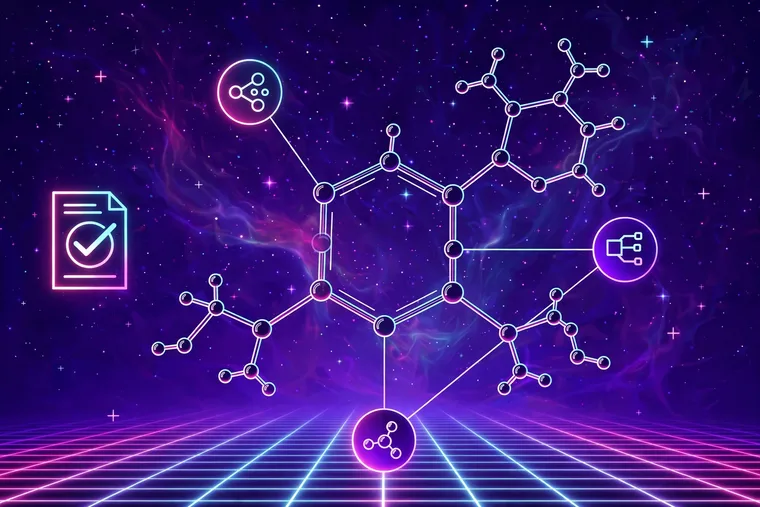
Vaporwave illustration of a molecular structure ringed by three connected agent nodes, with an audited document bearing a checkmark, in neon pink and cyan

Inside the MADD Console

Screenshots - validation runs
The KRAS G12C target run, open in the console: four ranked covalent-inhibitor candidates, each with its computed identity in the build guide. A pipeline validation against a target that already has approved drugs; the candidates are computational proposals, not made or assayed compounds.
Run detail for the MTCH2 inhibition run: the candidate molecule in 3D beside the receptor structure on file, the AlphaFold predicted model for MTCH2, labelled predicted. The candidate has not been docked; no binding pose is shown or claimed.
The build guide panel: the first MTCH2 candidate production-ready, with its synthesis steps and identity checks; the second recorded not ready, and anything the designer left unspecified named rather than filled in.
1 / 3

Select any screenshot to view it full size.

04

About

Variant Research Group is the company behind VRG Labs. Its products are software tools, each one built to solve a specific, real problem, and each one documented as exactly what it is: what works and what is still in development.

That standard runs through everything the company ships. Claims are checked against the work before they are published. Limits are stated plainly, where users can see them.

FitForward came out of a real job search that needed something better than a folder of resume versions. Secret Guarden exists because regulated data passes through too many systems with too little protection. WARDEN is a ground-up replacement for the laboratory information systems that lab work runs on. MADD is drug design held to an audit standard: candidates are easy to generate and hard to trust, so the evidence behind them gets checked before anything is designed.

Questions about any of the products, or about an interface that needs building, go to the contact address below.